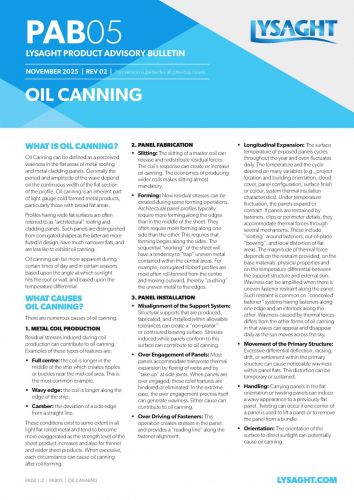
Product Advisory Bulletin - PAB05
If you read this article, you’ll learn what oil canning is, why it naturally occurs in flat areas of light‑gauge steel cladding, and why it’s most visible on wide architectural panels. You’ll also understand how lighting, temperature, and viewing angle influence its appearance, and why it is considered an inherent aesthetic characteristic rather than a functional issue.
Oil Canning in Light-Gauge Steel Panels
Oil canning refers to visible waviness or distortion in the flat areas of light‑gauge, cold‑formed steel cladding. It is an inherent characteristic of these products and is influenced by lighting, temperature, and viewing angle. While it may affect appearance, it does not impact structural performance or weatherproofing.
What Causes Oil Canning?
- Residual stresses from manufacturing and forming processes
- Uneven or non‑uniform substrate
- Thermal expansion and contraction
- Surface finish and lighting conditions that accentuate reflections
- Installation issues, such as over‑tightened fasteners
- Handling or storage that twists or stresses panels
How to Reduce or Control Oil Canning?
- Use narrower panel widths
- Specify a thicker gauge material
- Ensure a flat, uniform substrate
- Allow for thermal movement in design and fixing methods
- Avoid over‑tightening fasteners; follow correct installation practices
- Choose finishes such as COLORBOND® Matt or COLORBOND® XRW to reduce visual impact
- Handle, store, lift, and carry panels correctly to avoid twisting or point loading
Key Takeaways
- Oil canning is primarily an aesthetic phenomenon, not a structural defect.
- It is inherent to flat‑pan metal cladding and cannot be completely eliminated.
- Good design, material selection, and installation practices can significantly minimise its visibility.