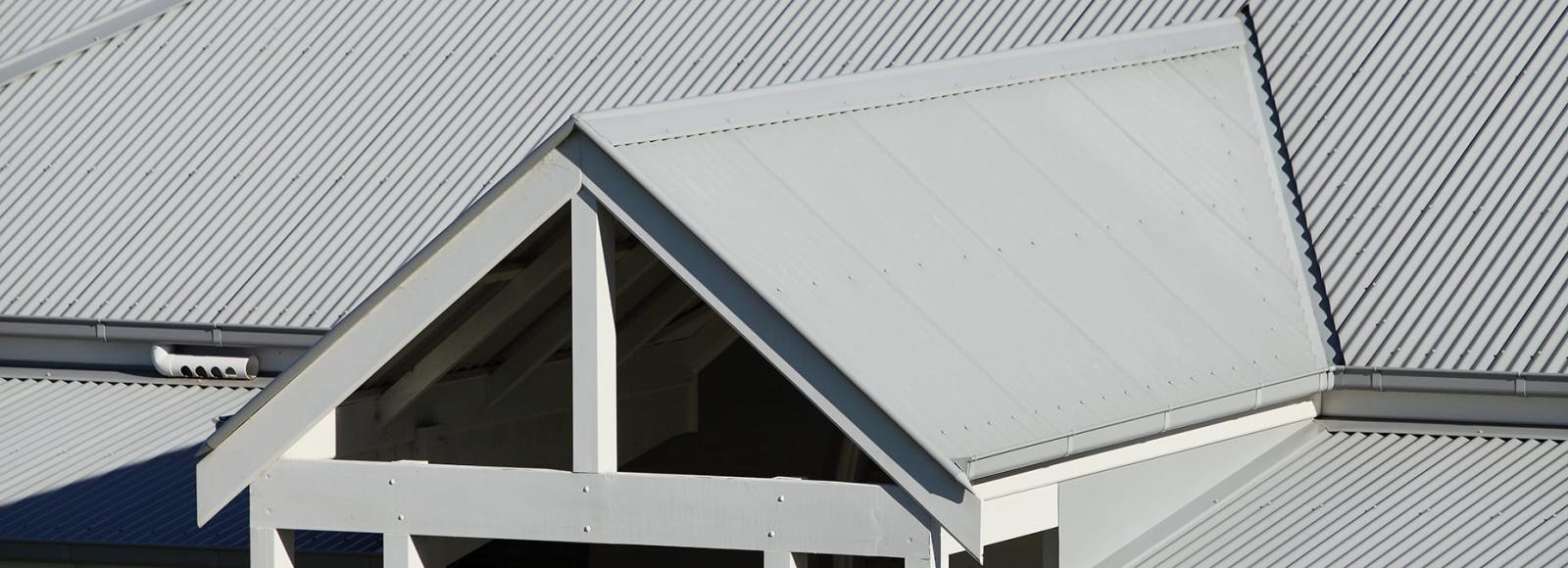
When the air in a building is warmer than the cladding, water vapour (moisture) in the air can build up on the inside of the cladding. This condensation can lead to deterioration of building components and staining of ceiling and walls. If insulation blankets or batts are wet, or even slightly dampened by condensation, its efficiency is reduced markedly.
Controlling the Effects of Condensation
The amount of condensation depends upon the amount of water vapour in the air, and this varies with climatic conditions. Activities within a building can add substantially to the amount of water vapour, and typical domestic situations include: bathing, showering, cooking, washing and drying clothes and dishes, and even breathing!
To minimise the risk of condensation on the underside of roofing, a vapour barrier is often used to prevent contact of warm moist air with the roofing – reflective foil laminate is commonly used.
To reduce condensation on the underside of the laminate, the laminate must be draped between roof supports so that the cold cladding is not in contact with the laminate (except at the supports).
NCC 2022 Housing Provision Standard Part 10.8.3 - Ventilation of Roof Spaces
The National Construction Code (NCC) 2022 introduced significant changes to condensation management provisions to reduce health risks and building damage in new homes. Key changes include requirements for external wall construction, exhaust systems and roof space ventilation, particularly in colder climate zones.
The changes apply to Class 1 buildings (houses), sole-occupancy units of Class 2 buildings (apartments), and Class 4 parts of buildings.
Key NCC 2022 Condensation Management Provisions
1. Exhaust Systems (Part F8D4/10.8.2)
All exhaust air from wet areas has to be ducted externally to the outdoors. Discharging into the roof space is no longer permitted.
- Ducting: All exhaust fans (kitchen, rangehoods, bathrooms, laundries) and venting clothes dryers must discharge directly to outdoor air. Recirculating rangehoods are generally not compliant as they return moist air to the room.
- Flow Rates: Minimum flow rates remain at 25 L/s for bathrooms/sanitary compartments and 40 L/s for kitchens/laundries.
- Interlocking Controls: In bathrooms or sanitary compartments without sufficient natural ventilation (e.g., small or no openable windows), the exhaust fan must be interlocked with the light switch.
- Run-on Timers: Interlocked fans in non-naturally ventilated rooms must also have a run-on timer to continue operating for at least 10 minutes after the light is turned off.
- Make-up Air: Rooms with an exhaust system but without sufficient natural ventilation must be provided with make-up air, typically via an opening to an adjacent room with a minimum free area of 14,000 mm² (e.g. a door undercut).
LYSAGHT COREGUARD®
LYSAGHT COREGUARD® is a 3-layer, vapour permeable membrane designed for commercial and residential walling applications. This membrane provides an effective barrier to the effects of weathering and resists the passage of water, dust, and other particles into the building substructure.
The breathable membrane is designed to provide dependable moisture control, an essential component in maintaining the durability and integrity of buildings. By allowing moisture to escape while preventing water ingress, the membrane helps protect structures from mould, mildew, and other moisture-related issues.
To ensure the maximum performance of the LYSAGHT COREGUARD® system, Lysaght supplies the Double-Sided Tape and Jointing Tape that have been specifically designed to support the correct installation of the membrane.
Ventilation Devices available from Lysaght
- Corex Cor-Vent® - Cor-Vent® Standard Pitch Roof & Cor-Vent® Low Pitch Roof
- Karben Guard® Ventilation Ember Mesh
- Bradford Wind Master Roof Ventilator
- Ampelite Spinaway and Superflow Roof Ventilators
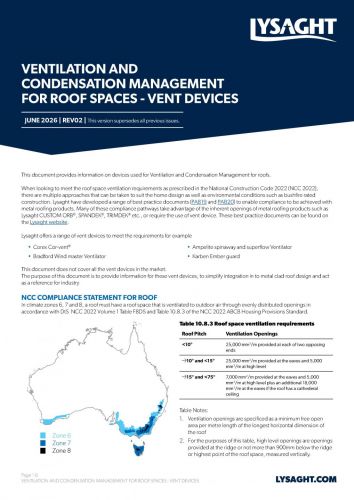
Availability varies nationally, please check with your local branch for your ventilation device options.
To prevent condensation with Lysaght products, maintain airflow by using a passive ventilation systems to allow air circulation and remove moisture. Proper installation also involves using appropriate breathable membranes, draping them to avoid contact between the roof and the laminate, and ensuring sufficient ventilation openings at the eaves and ridge.
Installation and design
- Use a vapour barrier: A vapour barrier can prevent warm, moist air from reaching the cold roof cladding, which is a primary cause of condensation.
- Ensure proper membrane draping: Drape the laminate between roof supports to prevent the cold cladding from coming into contact with the laminate itself.
- Provide sufficient ventilation openings: Meet National Construction Code (NCC) requirements by providing adequate ventilation openings at both the eaves and the ridge to allow for air exchange.
Other considerations
- Regular cleaning: Periodically cleaning the surface of your Lysaght cladding with a mild soap and water solution can prevent a buildup of dust and dirt that can absorb moisture and lead to corrosion.
- NCC requirements: Be sure to design and install your roof to meet the specific requirements of the NCC, especially concerning condensation management in your climate zone.
For more information about Condensation Management, please review the following documents
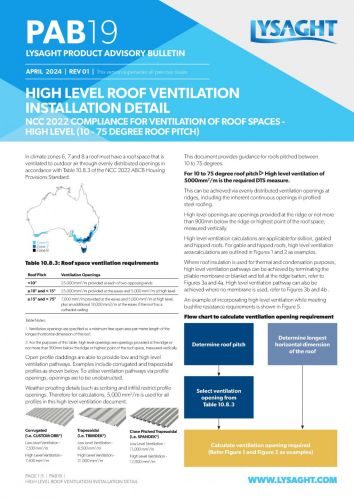
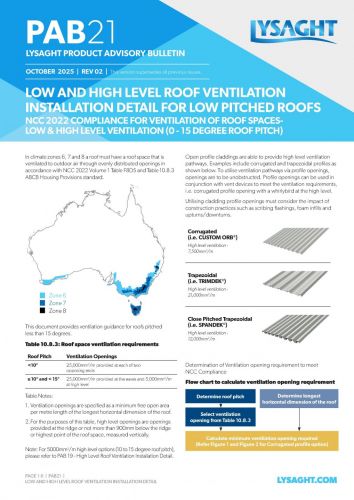
For further details you can reference the following ASI Fact Sheets;
- Metal-roofing-and-condensation.pdf (steel.org.au)
- Vapour-barriers-and-metal-roofs.pdf (steel.org.au)
- Blanket-and-foil-insulation-of-metal-roofing.pdf (steel.org.au)
- Fact-Sheet-Eave-Ventilation.pdf (steel.org.au)