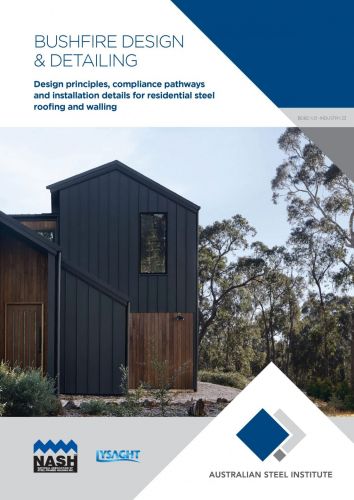
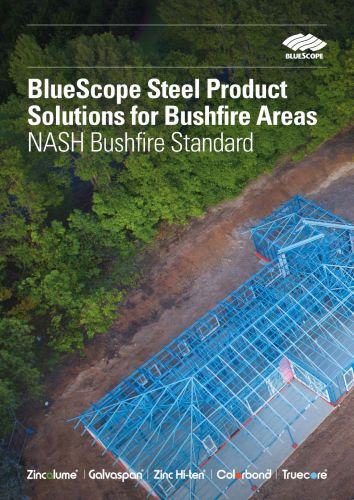
Bushfires are simply a part of Australian life. Every year, fires of various sizes impact communities across different states and territories, and often lead to significant human, environmental and property losses.
The BAL Rating System
Australian Standard AS 3959 (AS 3959-2009) was introduced to mitigate risks, by focusing on the construction of buildings in bushfire-prone areas. One key component of this standard is the Bushfire Attack Level (BAL) rating system.
The BAL rating assesses the potential risk facing a home in the event of a bushfire. It measures the level of heat flux, which is the rate of energy passing through a surface, taking into consideration factors such as ember attack, radiant heat and direct flame contact. This measurement is crucial for determining the construction requirements and building materials needed for homes in at-risk areas.
There are six BAL ratings defined by the Australian Standard:
BAL-Low: This is the lowest risk rating, where no special construction requirements are mandated, although some jurisdictions may have minimum standards.
BAL-12.5: A low-risk rating acknowledging the potential for wind-ignited embers and burning debris. Specific construction requirements apply.
BAL-19: Moderate-risk rating with increased levels of ember attack and heat flux up to 19 kW/m². Additional construction requirements are necessary.
BAL-29: High-risk rating indicating a significant risk of property damage from bushfires, including higher levels of ember attacks and heat flux up to 29 kW/m². Extensive building requirements come into play.
BAL-40: Very high-risk rating with a strong possibility of ember attacks and direct exposure to flames, featuring a heat flux of up to 40 kW/m². Construction precautions are essential.
BAL-FZ: Reserved for extreme locations with a high risk of ember attack and exposure to radiant heat and direct flames. Specialised construction is imperative.
Construction considerations for BAL-affected areas include the use of appropriate materials and building design directives, such as:
- Non-combustible materials for external walls, roofs, gutters and downpipes.
- Keeping roof designs simple to minimise debris accumulation.
- Minimising open spaces under floors and decks.
- Eliminating gaps between walls and roofs.
- Avoiding re-entrant corners to reduce fire risk.
CSIRO Test Results for COLORBOND® steel
CSIRO research has confirmed that COLORBOND® steel performs well in bushfire conditions, including the extreme Bushfire Attack Level – Flame Zone (BAL-FZ).
How COLORBOND@ Steel performs in Bushfire Zones
- Non-combustible: COLORBOND® steel is non-combustible and will not catch fire or release toxic gases during a fire.
- Bushfire-resistant: CSIRO tests found COLORBOND® steel performs better than other materials and is suitable for use in high-risk areas like BAL-FZ when installed correctly following all bushfire design principles.
- Flame immersion test: In a 30-minute flame immersion test, COLORBOND® steel showed excellent performance.
LYSAGHT® roofing and cladding products made from COLORBOND® steel or ZINCALUME® steel are excellent choices for BAL-rated areas, as they do not ignite or contribute to the spread of fire. These products offer both safety and aesthetics, ensuring homes meet BAL requirements without compromising on design.
Steel fencing is a great first line of defence.
CSIRO’s research and investigation into the performance of residential boundary fencing in bushfires found that steel fencing provides more protection to people’s homes against bushfire than other alternative materials, because of its non-combustibility, and its ability to help mitigate building-to-building fires.